A Five-Question Plan for Discussing One Casino Scene
A five-question plan for discussing one casino scene helps a group notice craft, compare interpretations, and leave with a sharper reading of the story.
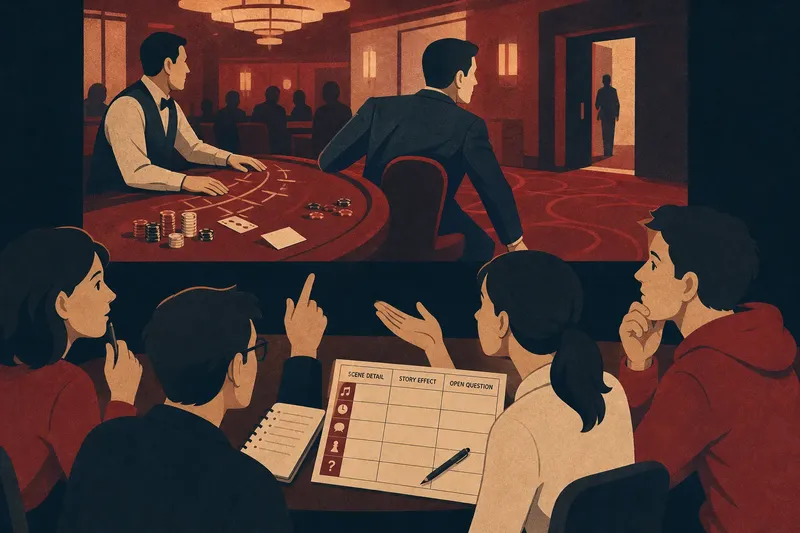
The pause button lands on a casino scene just as a character turns from a card table toward the door. In a shared reading at HIU, one person may call the turn a sign of fear; another may see a character weighing a choice. A five-question plan for discussing one casino scene can help the group examine how the story makes room for both readings.
The conversation is about craft: the scene’s framing, rhythm, dialogue, and place in the larger story. Treating those choices as a puzzle keeps the focus on how a fictional moment is built, rather than on claims about real casino visitors, staff, or gambling.
What is the scene’s dramatic question?
Start with what the moment is asking the audience to wonder. Is the character about to leave, confront someone, or change their mind? A scene’s dramatic question can be clear even when its answer is not.
Describe the action in plain language before debating its purpose. “The character looks at the door after the dealer speaks” gives everyone a shared starting point. “The character is ashamed” is one possible reading, but it needs support from the scene.
How does the scene control its pace?
Notice the sequence of beats. Does a long pause stretch the anticipation, or do quick cuts make the exchange feel compressed? Listen for when the soundtrack begins, changes, or drops away. These choices shape the scene’s rhythm much as pauses and emphasis shape a sentence.
Timing can also alter a prop’s role. A chip shown before a character makes a choice may become part of the buildup; shown afterward, it may point attention toward the consequence. The object itself does not carry one fixed meaning—the scene’s arrangement gives it emphasis.
What changes from the start to the end?
Track the character’s immediate goal, obstacle, and shift. Perhaps someone enters hoping to deliver a message, finds the intended listener surrounded by other people, then changes course. That small turn can give a scene momentum without explaining every character’s history.
Ask what the ending changes for the next scene. It might supply new information, sharpen a conflict, or leave the character’s choice suspended. This question connects the casino setting to the story’s structure instead of treating the location as the whole subject.
Which questions help readers compare interpretations?
How can I tell a scene’s mood from its plot?
Plot is what happens; mood is the feeling the presentation encourages. A character can be calmly arranging cards while a low musical note makes the moment feel uneasy.
Does every prop need a symbolic meaning?
No. A prop may simply help a scene function, establish its setting, or give a character something to handle. If a reading assigns it a larger meaning, point to how the story emphasizes or revisits it.
How can I connect one scene to the larger story?
Look for a change in a relationship, goal, or piece of information that carries into a later moment. If the connection is not visible in the material you have watched, keep it as a question rather than filling the gap with an assumption.
What if viewers remember the scene differently?
Return to the clip if it is available and compare the details each person recalls. If it is not, record the competing memories and avoid building a firm reading on a disputed detail.
What should the group check before settling on a reading?
- Check the dramatic action: If everyone can name the same visible action, use it as the shared starting point; otherwise, replay the moment or record the disagreement before interpreting it.
- Check the timing of a sound or prop: If the scene clearly emphasizes when it appears, discuss how that placement shapes attention; otherwise, describe it without assigning it a special role.
- Check what changes for the character: If a goal, obstacle, or choice shifts, connect that change to the scene’s structure; otherwise, keep the reading focused on atmosphere or detail.
- Check the dialogue against the interpretation: If a line supports the proposed motive, include it in the reasoning; otherwise, describe the motive as unresolved.
- Check whether a reading depends on later scenes: If the later material is available, compare the scenes; otherwise, mark the connection as a question rather than a settled explanation.
- Check who is driving the conversation: If one person has spoken at length, pause and invite someone else to point out a craft choice; otherwise, continue by comparing the details already named.
Imagine an invented HIU discussion of a scene that begins with a character placing a folded note beside a card table. The group first writes down three starting details: the note is visible, the dealer continues speaking, and the character glances toward a nearby doorway. They replay the clip and hear that the music begins after the glance. One reader interprets the timing as suspense; another says it emphasizes the character’s hesitation. The group then checks the dialogue and finds no explanation of the note or the glance. Their resulting reading is specific: the music heightens the pause, while the character’s purpose remains open.
A simple page with columns for “scene detail,” “story effect,” and “open question” can preserve that distinction. For example, “music starts after the glance” belongs under detail, “the pause feels suspenseful” under effect, and “why the character looks toward the door” under open question.
Near the end of a five-question plan for discussing one casino scene, ask each reader to name the craft choice that most shaped their interpretation. That answer gives the group a useful bridge to the next scene: watch for whether the story repeats the choice, changes it, or leaves it behind.